A space to discover what the Source Arts have to offer and teach. As a Source Artist I will post and explore the conceptual and development process of the Cultural Fusion art series and the socially purposeful art movement. My primary interest is in advancing art based research to illuminate new opportunities and valuable insights.
Showing posts with label meaningful marketing. Show all posts
Showing posts with label meaningful marketing. Show all posts
So much attention has been given to social media - monetizing it to justify the time and attention investment...and meaningfulness of networking.
The sustainability of the work has been an obvious consideration from the start and in that nailing down a simple to understand service serving a market that is growing was not as easy as I initially expected.
On one Side: Helping Luxury Service Providers advance relationships with women who want responsible luxury goods/services. Product - Podcast production with strategy - I produce purposeful conversations and create an engaging context for sharing them.
On the other side: I provide value to my social network by selecting people and their brands to be featured or introduced to a new market.
For obvious reasons I am interested in both all this personally and as sign posts of social evolution. I love exploring these ideas and will continue to do so, but unless I am only interested in conversing with myself I have had to do a better job of connecting with others.
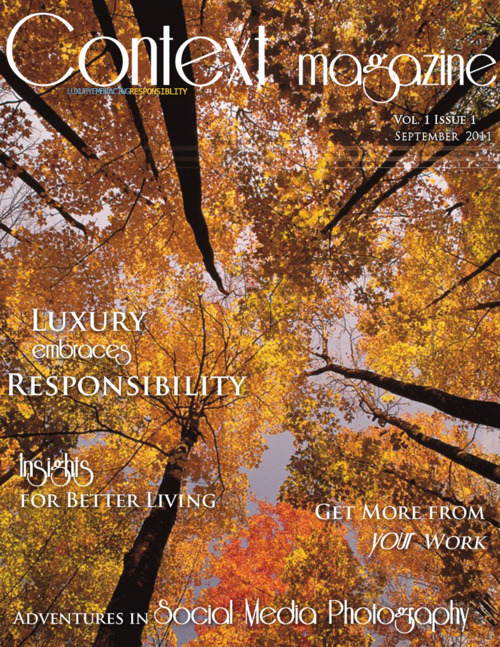
The concept for Context Magazine is an experiment in Magazine as Interactive Art and exploring the potential of social media as part of an inclusive value creation infrastructure. The artworks are Art-i-facts in an Art Based research series about inclusion, social responsibility and women supporting each others highest expression...especially finding mediums work to engage more change agents across typical demographic divides.
For quite some time in the research aspects of Art Based inquiry I struggled to find a media that inspired me, allowed me to bring those ideas together and was accessible to the people I wanted to engage. I think we are making similar use of social media to move ideas forward and so I am curious about what our inquiries have in common.
Big ah-ha was realizing the magazine as a conceptual vehicle facilitates bringing together groups that are sometimes socially conditioned to resist each other.
Plenty of idealism boiled down to a conversation about using flip-page magazine channels as alternative distribution to replace the function and eliminate the barriers of the gallery. Very much the way that other artists are exploring how to use the internet and social media to disseminate public art...I am interested in defining Art Based Solutions as part of a model for community change.
In Context Magazine I want to embrace the opportunity to develop accessible collaborative artworks that help the business agenda and the BIG dreams...allow women to feel inspired and supported by sharing stories of the journey that give our lives Context.
The Free eCourse builds on helping people make better strategy decisions by learning to better understand the context of their problems and Solutions. I am really happy about this progress in being able to show how this Art Based Solution emerged.
With the dismantling of community mental health system and the erosion of personal support networks new alternatives must be devised. Currently I am working cf House of Cards series with that forming a recurring imagery/concept to be confronted. In contrast to the typical approach of assuming only bureaucratic systems can explore and solve these challenges, Cultural Fusion is interested in addressing them in the context of self organization, freedom, personalization, social media/technology, ecology, economics and social evolution via art based research.
The results are multilateral solutions, an art series, that combine visual art (performance, media/software, recycled materials, installations, sculpture, paintings) as well as music and audio. That while operating as art, and community intervention – are also operating as business solutions that promote innovation in economic development.
This is an excerpt explaining our collaborative Cultural Fusion Art as Philosophy series as a demonstration of the SoulFood model I have been developing as a Source Artist.
While it advances the idea of “Self Referencing Creativity” it has been inspired by key scholarship in the areas of community mental health. As art imbued with this layered integration it seeks to pioneer new approaches to project/product development and management that promote a culture of peace. While at the business or economic level this is best understood from the perspective meaningful marketing, CRM Strategy and Global Social Responsibility; at the personal - community level it is chiefly as an expressive therapy approach to community intervention/prevention strategy.
This work is distinguished by its policy of Radical Inclusion - integrating mental health, arts and culture, history, economic development, and personal development that goes to the roots of several issues including: domestic violence, poverty, crime, depression, a host of “at risk behaviors”, etc. Rather than seeking to exclude needs, each person is allowed the time to identify and distinguish real needs from perceived ones. Resources and “intangible assets” are valued above lacks or deficits.
One of the primary benefits of this approach is its attention to integrity – starting with the integrity and transparency of the SoulFood:Ingredients included in any given project recipe. Here in this paper attention is on the community mental health model and theories that were the basis of the early inquiry into this work.
In beginning to approach community economic renewal my instinct was to go to the weakest links first – homeless, those needing mental health services, neglected seniors, those living in economic poverty, and the disenfranchised (included the previously incarcerated). The point of Radical Inclusion is that the needs of all sides seeking inclusive expression need to be brought to the table and integrated into the Recipe.
Client engagement is critical, and this is the basis of using interactive high art concepts with multiple components that also operate on the level of a project-based expressive therapy approach as opposed to traditional cognitive therapy to deliver community mental health intervention/prevention programs.
Primary experience, which exists apart from language, is described by language (a representation, or secondary experience). Language is that secondary experience created by verbalizing primary experiences. Verbal psychotherapy, then, is a procedure for the verbal processing of verbal descriptions of events. According to discourse theory, language constructs its own reality rather than corresponding to it.
Among those practitioners who use them for the purpose of representation, action methods generally are regarded as more vivid and memorable and having more impact than verbal methods. Action methods simultaneously engage cognition, affect, and behavior and better engage those clients who process information predominantly in visual and kinesthetic modes. When used as interventions, action methods provide novel ways of altering habitual patterns of thinking, feeling, and behaving.
According to some psychological theories, formative experiences that occurred at a preverbal stage of development can be accessed only by nonverbal methods. Also, there is evidence that traumatic experiences are stored or encoded differently from non-traumatic ones, suggesting that experiential therapies may have the potential to shift traumatic experience in cases in which verbal ones cannot.
“The map is not the territory.” Action methods get clients to venture into the territory of experience, enriching those clients who have come to rely solely on the maps of verbalization. Experiencing these methods provides both a way of discovery in terms other than verbal ones and material that can be juxtaposed with verbally encoded representations. In sum, action methods put verbalizations to the test of experience.
Although psychotherapy will continue to be a verbally mediated process, the inclusion of action methods appears to promote significant clinical change in relatively short periods of time, making them particularly valuable in brief therapy and with populations not very responsive to talk-only therapy.
Why use an empowerment-based model? Empowerment may be defined as a process through which people become strong enough to participate within, share in the control of, and influence events and institutions affecting their lives; in part, empowerment implies that people gain particular skills, knowledge, and sufficient power to influence their lives and the lives of those they care about (Torre, 1985). The process of empowerment is ongoing and involves changes in three dimensions of one’s self: personal, interpersonal, and sociopolitical participation.
The personal (self-perception) dimension involves attitudes, values, and beliefs about self-awareness, self-acceptance, belief in self, self-esteem, and the feeling that one has rights. The interpersonal dimension involves acquisition of knowledge and skills, assertiveness, setting limits on giving, asking for help, problem solving, accessing resources, critical thinking to participate and work with others in networks and systems of mutual aid and education in order to enhance the world they live in. The political dimension involves participation by joining appropriate social organizations, giving back by helping others, making a contribution, voting, writing letters, teach others what is learned, and taking control in generalized areas of one’s life are specific skills that will be cultivated during participation in this fully implemented program.
The underlying assumption of empowerment practice is that clients are generally disempowered through membership in devalued and oppressed groups; that the system of governmental policies and services is a barrier to achieving desired goals; and that learned powerlessness is an attribute of many clients (Albert and Green, 2002). Therefore, practical empowerment attends to power issues and promotes the creation and discovery of personal and group empowerment among clients. Affirmational Psychology a later model I learned of that contributed to the work and let to a few major project collaborations.
It is my hope that in sharing this document that others who have similar interests....working in related areas will contact me. I have finally had a breakthrough in visually connecting this series as it evolves and organizing the huge amount of content I have already generated. In conclusion a few links to key pages in the Development Workspace: Cultural Fusion Futurist This is one of the primary projects - an installation called cf House of Cards Installation i Defining Installation for SoulFood context